
PART1: Meet the world authority in lasers in ENT and a pioneer in laser surgery: Vasant Oswal, MBBS, MS, DLO, DORL, FRCS (Ed), FRCS (Eng.)
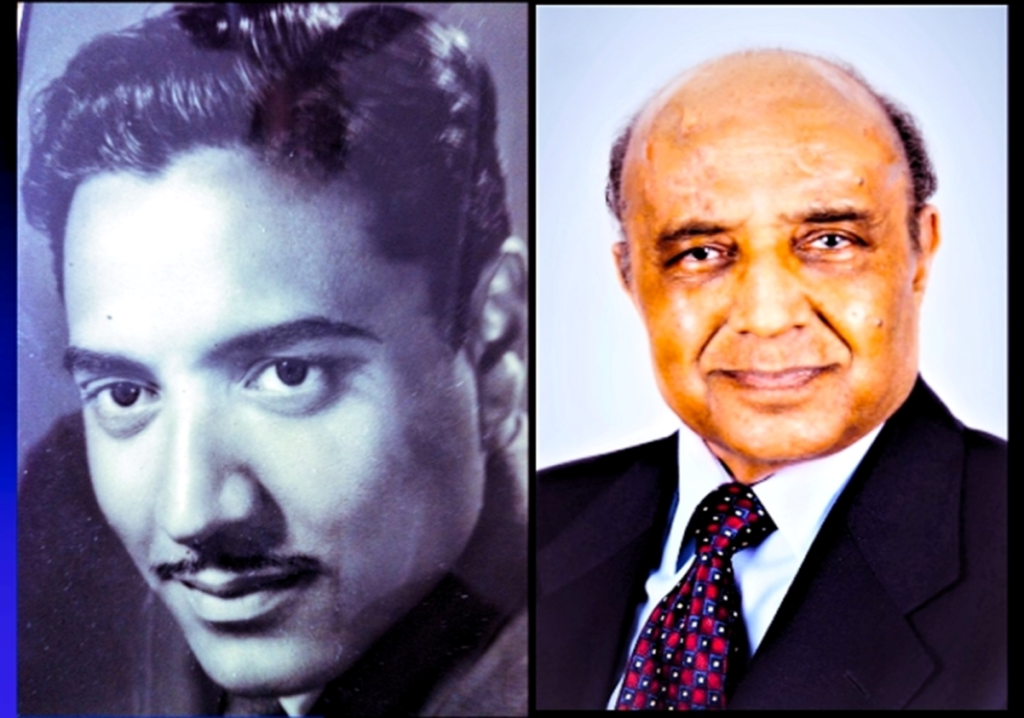
Vasant Oswal is an Emeritus Consultant Otolaryngologist and Head and Neck surgeon at the James Cook University Hospital, Cleveland, England and a recognized world authority in Lasers in ENT. Regarded as a pioneer in laser surgery in ENT in the UK, Vasant Oswal has written widely, authored and edited three books on lasers in ENT, and trained hundreds of surgeons in Cleveland International Laser Courses for over 28 years. He was also invited worldwide to over forty ENT centres to run laser course and chair conferences. He was made an Honorary member of many professional organisations He has been rightly awarded many prestigious honours throughout his long career. Amongst all, an award of FRCS by the Royal College of Surgeons of England by nomination and election, a rare recognition, stands proud.
Photo left: 1960 – 2022
At 87 years young and allegedly retired in 1995 as consultant, he is Vice President and Chairman of the Education Committee of the British Medical Laser Association, Secretary General of the European Laser Association and has recently authored an autobiography.
As recently as March 2022, The European Medical Laser Association awarded him the prestigious ‘LIFE ACHIEVEMENT AWARD’ during the New York 2022 Laser Meeting for his contribution to Lasers in Medicine.
We caught up with Vasant ahead of the 39th BMLA Annual Conference which takes places in Edinburgh on 25 – 27 May 2022 at the Royal College of Surgeons to ask him some questions about his life and career.
In this interview we found out more about Vasant and an insight into his career highlights spanning over long 62 years, what he is most proud of and the biggest changes he has seen in lasers in his lifetime….
What’s your typical day like now? How is it different from your daily routines in the past?
How do I answer this question? My daily routine in the past, working as an ENT H&N consultant, ended some twenty-seven years ago, on my retirement in 1995! Even long before retiring, I was invited to teach laser surgery in many countries worldwide. The travelling continued all these years; the last one was to Singapore for the Asia Pacific Laryngology Association conference in November 2019. And then we had the Covid lockdown in March 2020, stopping all my travelling and replacing it with a screen on the zoom platform. Many people in the past had asked me to write my biography. This was the opportunity. It kept me busy and is now ready to publish. The rest of the time goes in gardening, growing veg. That is better exercise than any gym equipment. And, for the hungry brain, YouTube. Many excellent documentaries on history, space, physics, chemistry, computers videos. I love watching them, those two or three hours of ‘rest’ for my brain!
What are your career highlights?
The only career highlight was when I wore a white coat and put the stethoscope around my neck on that first day in medical college. A saviour of the world? YES, that’s me. Most of my career was governed by unplanned events and unexpected turns in my life! As I was finishing my postgraduate studies in India, a letter arrived from the North Riding Infirmary in Middlesbrough in England, just 5000 miles away, for an interview to fill in a Senior House Officer post. They needed resident doctors, one of my friends was working there. He suggested to them to write to me, and within ten days, from the warm sunshine of Bombay (Mumbai, as it is known now), I was in wintry England on 11th November 1963!
Photo left: Training of the theatre staff
Then, after finishing training and passing FRCS, I was about to go to Libya to work there as a consultant in 1969 for two years; before returning to India. But it did not happen! My appointment was by King Idris Regime, who was deposed in a military coup by Colonel Gadhafi a night before I went to the Libyan embassy in London for a visa. They said, ‘we don’t know if we are legitimate as Embassy staff, so how can we give you a visa?’
Suddenly, all my plans fell apart. The regional NHS office in Birmingham found a locum job for six months in Wales – giving me a breather. One day, the consultant there said, ‘Have you thought of working here as a consultant?’ I applied for a job in Middlesbrough and, as they say, the ‘rest is history’.
I believe the Russia and Ukraine conflict impacted you – Can you tell us how?
I was invited to St Petersburg by the Head of the ENT department Marius Plouznikov in 1991, soon after the collapse of the USSR, to train the young surgeons from the old USSR countries, which included Ukraine, Chechnya, Belarus, Kyrgyzstan, Kazakhstan, Estonia, Latvia, Lithuania and other countries. Every two years, I went to St Peterburg and chaired the International Academy of Otolaryngologists and Head and Neck Surgeons, Russia. I trained them in presentation skills, spoken and written English, writing articles and research methods and many other skills. When the young trainees presented their work. I chaired the Jury selection Committee to select the best presentations. The awards consisted of observer status for two weeks in the ENT departments of many countries of Europe and also the US. For my work, I was awarded a title of ‘Distinguished Otolaryngologist’ and an ‘NP Simanovskii Gold Medal’, exceptionally to a non-Russian. When Marius passed away, Sergei Karpischenko became the head of the StP Department of Otolaryngology. He is one of many young surgeons I trained years ago, and he proudly mentions my name as his trainer.
The thought that some of my trained Ukrainian Surgeons may be involved in the war saddens me. Medicine has no boundaries and cannot take sides. Nevertheless, I feel all my work to ‘westernise’ the old USSR trainees will come to an end and Russia will go back to the times before they invited me to train the young doctors in the 1990s.
What dreams and goals did you have for your life when you graduated in medicine?
My career, both before and during medical studies, had been scholarly. I was therefore keen to take up postgraduate studies after I passed MBBS in 1960, way back when penicillin was making inroads all over the world. By 1963, I had taken and qualified in all the postgraduate examinations in India. Any further studies were only possible by going abroad. FRCS was very much respected at that time as the ultimate qualification. So, I came to England and passed DLO in 1964 and FRCS in 1967. with no more examinations left to take, the dream was over; time to start working!
What are some of the most significant changes in lasers you’ve seen in your lifetime?
The sophistication has achieved more precision and less collateral (unwanted) damage. This is very important in the surgery of the disease of the vocal folds in the larynx. Any spread of the laser energy to the normal vocal fold would damage the integrity of its structure and result in a hoarse voice. The spot size in my first machine in 1982 was 700 microns in diameter. It came down to 250 microns, a quarter of a millimetre. The exposure time also got smaller. A superpulse technology gave an activation time for the laser strike, lasting only one four-hundredth of a second. A sharp, precise incision was thus possible at the junction of the tumour and the normal vocal fold. Narrow-band imaging defined the blood supply to the tumour. Sealing it off with the laser slowed down any re-growth of the tumour. Hand in hand, the emphasis for surgery on the voice box has shifted from removal of unwanted tissue to preservation of function as the primary aim, even in cancer cases. There was much hope for robotic laser surgery in the voice box and beyond, but we have not been able to concur with the technology for that.
What is the most innovative medical product you’ve worked on in your career?
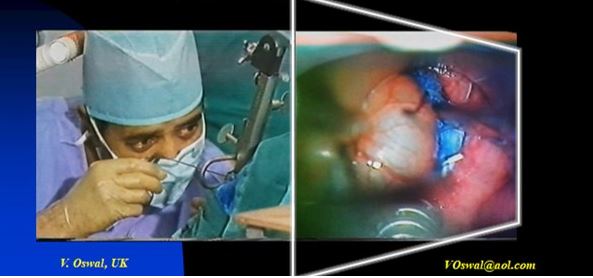
It has to be laser technology. I have been following it since a conference in Toronto in 1972 where a prototype was in the trade exhibition. The experimental machine was ten feet long! Over the next few years, the development continued until the device was a washing machine size and ready for its introduction in surgical practice. The laser was a game-changer, a beam that cuts the tissue with precision and, at the same time, shrivelling small size blood vessels, making the surgery almost bloodless!
Do you enjoy a slower pace now, or are you as busy as ever?
I have never been in a slow lane; for me, every lane is a fast lane. I have so much to do every day that I run out of time. Your very pertinent question reminds me of a story of a man who dug a hole in the garden, dug the next hole, and filled the first one with the soil from the second hole. He continued doing this for every hole he dug in. The neighbour asked him why he dug a hole and filled it again with the soil from the next one. ‘Oh, I am just moving the hole from one side of the garden to the other side,’ was his answer. I will be doing just that – moving a hole if I run out of anything else to occupy me!
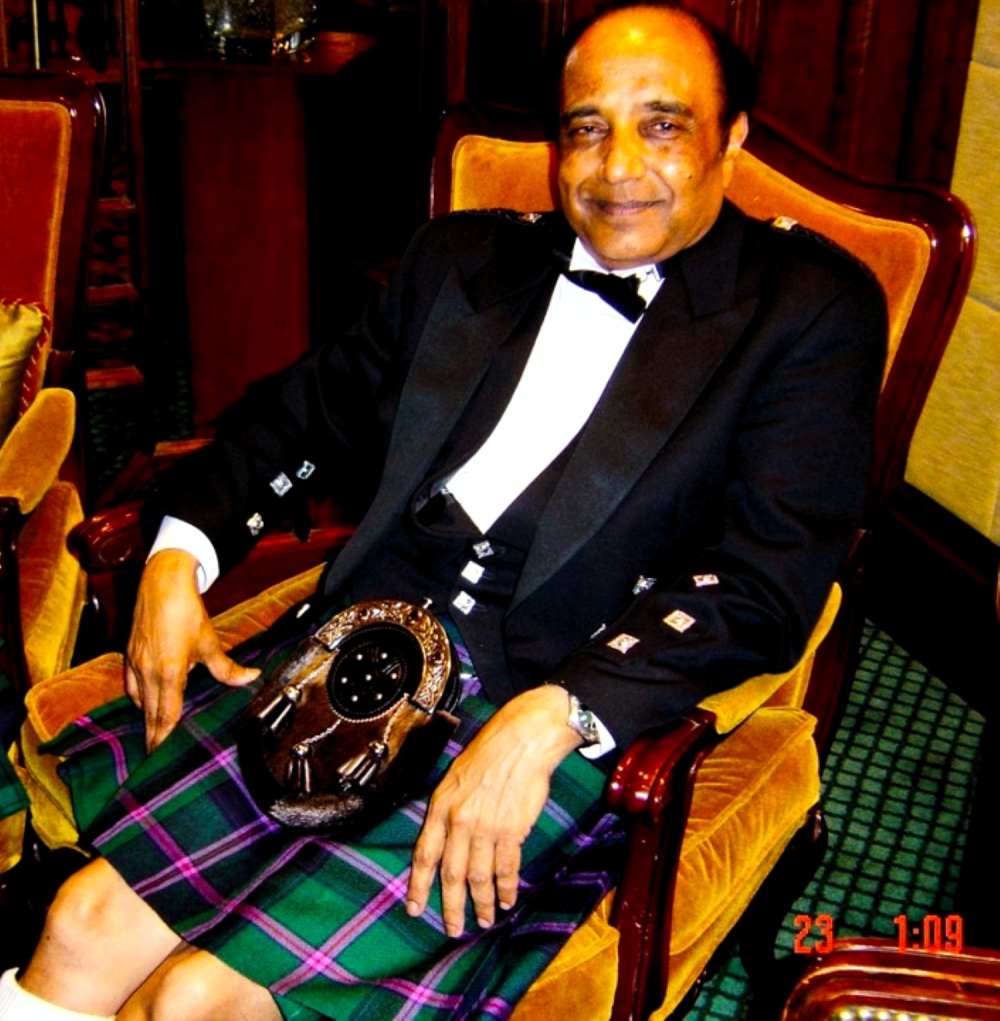
Photo left: Vasant in Kilt during The Joint Conference of the USA, Europe and the British Laser societies in 2003
To be continued….
Part 2 of this interview will follow soon. Stay tuned!
Brief CV
Vasant Oswal was born and bred in Pune, a hundred miles southeast of Mumbai, India, in 1934, before the Second World War when there were no cars or buses on the road, and public transport was by horse-drawn carriages called Tonga.
In 1960, he qualified in Medicine from BJ Medical College in Pune. His post-graduate medical career started in Bombay (now known as Mumbai), where he passed the DORL in 1961 and MS in ENT in 1963. He moved to England for further training and was awarded the DLO (RCS) in England in 1964. An FRCS Edinburgh followed in 1967.
After he was appointed Consultant in ENT in 1969 to the North Riding Infirmary, Middlesbrough, he initially specialised in otology. He undertook temporal bone dissections exhibited in the Welcome Museum at the RCS and later photographed and published in the Colour Atlas of Anatomy, produced by Prof McMinn and Hutchings.
In 1974, he received international acclaim in Toronto, Canada, for his method to manage laryngeal cancer involving a team. He was awarded a scroll: “Team concept in the management of laryngeal cancer”, now routinely practised by a group known as a multi-disciplinary team (MDT).
He was always interested in innovation. He foresaw the benefits of laser surgery in the larynx in the late 70s and raised funds to buy a CO2 laser for his department in Cleveland in 1982. He developed bespoke instruments for laser surgery in the larynx, including a flexible metal anaesthetic tube, marketed as Oswal Hunton flexo-metallic fireproof anaesthetic tube. He established the Cleveland International Laser course, which ran for 28 years, teaching laser techniques to numerous UK and international surgeons. He also travelled widely at the invitations of ENT centres worldwide and received many honours for his dedication.
In 1992, he took up the role of Editor in Chief of a bi-monthly publication, ‘ENT News’ and developed it. With 18000 copies distributed in 50 countries, it is the most read bimonthly ENT magazine.
Following his formal retirement in 1995, he was appointed as an Honorary Consultant surgeon and continued practice until 2008, when he received an appointment as an Emeritus Consultant surgeon. In his honour, the James Cook University hospital named a consulting room ‘Oswal Rhinology Lab’. He continued writing, teaching and editing three major books regarded as reference books.
Not content to relax clinically or academically, Vasant had been a significant driver and supporter of developing the Deenanath Mangeshkar Hospital and Research Centre in Pune (his hometown) over the last decade. He developed a world-class facility in laryngology at this non-profit 1000-bedded hospital. The hospital is the first and the only centre outside the UK and Ire to receive accreditation, ‘Centre for Surgical Education and Training’ by Royal College of Surgeons of England. They also awarded him Fellow (FRCS) by Election in 2014 for his contribution to academia, spanning over half a century.