We are delighted to announce Prof Reem Hanna, BMLA Executive Board Member, and Vasant Oswal MBBS, DORL, MS, DLO, FRCS, BMLA Vice President, have been awarded lifetime achievement awards at the European Medical Laser Association (E.M.L.A) virtual conference (March 2022) in recognition of their work over many years in the field of lasers.
Reem was also presented with the ‘Best Paper’ Award at the E.M.L.A conference. The published paper in the Antioxidants Journal (Q1, IF: 6.3) March 2022 was based on Reem’s clinical trial in utilising photobiomodulation therapy in oral neuropathic pain management compared to pharmacotherapy at the European Medical Laser Association (E.M.L.A ) virtual Conference.
Prof Reem Hanna, Associate Specialist in Department of Oral Surgery, King’s College Hospital NHS Foundation Trust, UK, Registered oral surgeon in UK, Professor in Department of Surgical Sciences and Integrated Diagnostics, University of Genoa, Italy and Honorary Associate Professor at UCL-Eastman Dental Institute, London, UK says:
“It is an honour and privilege to receive the best paper and lifetime achievement awards from the E.M.L.A ‘s scientific and organisation committees. I would like to thank E.M.L.A for recognising my valuable contributions to the laser therapy community”
Vasant Oswal, an Emeritus Consultant Otolaryngologist at the James Cook University and a recognized world authority in Lasers in ENT says:
“I am pleased to receive the Life Achievement Award from the European Medical Laser Association. The 2022 New York Laser Meeting was full of interesting papers and the meeting president Dana York deserves applaud for bringing the world audience to the Zoom platform, considering a timely coverage along so many time zones.”
Many congratulations Reem and Vasant from your friends and colleagues at the British Medical Laser Association (BMLA).
The BMLA, its Secretary Dr Jonathan Exley, and President Dr Vishal Madan, were recently privileged to award Dr Sean Lanigan a BMLA Honorary Membership in recognition of his significant contribution to the promotion and development of light associated techniques for diagnosis and treatment, in addition to his continues support of the aims of the BMLA and contributing to the success of BMLA annual scientific conference.
Dr Lanigan MD FRCP DCH, retired from private practice in 2020, as a Consultant Dermatologist at Sk:n in Birmingham. He was Group Medical Director, Regional Medical Director and Co-Founder of the Medical Standards Committee of Sk:n, which is the largest provider of aesthetic treatments throughout the UK.
Additional career achievements have included:
Consultant Dermatologist and clinical lead at the Birmingham Regional Skin Laser Centre, City Hospital Birmingham (2001-2009)
President of the British Cosmetic Dermatology Group (BCDG) (2015 to 2017)
Executive Committee Membership of both the British Medical Laser Association (BMLA) and the American Society for Laser Medicine and Surgery (ASLMS)
Editor in Chief of Lasers in Medical Science for 8 years.
Editorial Board member of 3 leading laser journals.
External Advisor for the Medical Devices Agency and National Institute of Clinical Excellence (NICE).
Authored over 160 scientific medical publications including 2 text books and 16 book chapters.
Dr Lanigan was delighted to accept the membership and said: “It is an honour to accept Honorary Membership of the BMLA. I first joined the BMLA in the mid 1980s after my exposure to dermatological lasers, which were in their infancy, under the supervision of Dr Jill Adams and Professor Steve Bown. I have been a strong supporter and member ever since – as the BMLA was, and continues to be the most important voice in Medical Lasers in the UK”
BMLA Secretary, Dr Jonathan Exley also thanked Dr Lanigan for his excellent contribution to the BMLA conferences. Dr Lanigan has played a major part in the success of the annual scientific conferences and has always been a positive conference ambassador telling us “the annual scientific meeting was an invaluable resource for the presentation of new research across all medical laser disciplines. It was also the venue for practitioners primarily in the UK to discuss ideas and problems with peers and experts.”
Dr Lanigan recalls many highlights of the BMLA conference. ”One of the standout features is the unbiased presentation of scientific research underpinned by strong scientific principles. I have been gratified to contribute scientific papers, teach and participate in debates at the meeting over many years. Many of my junior researchers had the opportunity to present and learn at the meeting. I was also delighted to present the Vasant Oswal Oration at the Laser Skin and Body Conference, co organised by the BMLA in Rotterdam 2018, ‘Why are we still having difficulty treating port wine stains?’”
He added:
“The BMLA annual scientific meeting was also a great social occasion, and it is particularly pleasing that the first in-person conference since the Covid pandemic is taking place in Edinburgh in May, this year. Welcome back!
The BMLA has also taken a lead role in publishing guidance documents which have been invaluable to practitioners particularly in the field of aesthetic lasers, and I was pleased to be able to contribute to some of these.
I am therefore delighted to receive this honour from such an important, vital and prestigious organisation as the BMLA. It is particularly pleasing to see that the BMLA continues to be such an important organisation and I wish it continued success in the future”
The British Medical Laser Association (BMLA) was founded in 1980 and is the foremost society in the UK for users of lasers, light and energy based devices for medical, surgical and dental professionals and allied colleagues, including but not limited to: nurses, technicians, scientists, aestheticians, manufacturers, suppliers, safety advisors and individuals with an interest in these areas.
The British Medical Laser Association would like to say a very big thank you and goodbye to Clare Beach from Azura Events, for her services as Association & Conference Manager with BMLA, as she has handed over the reins last month.
Clare has been an invaluable anchor and helped develop and grow the BMLA since coming on board in 2015 and thanks to her leadership, attention to detail and the processes she has implemented, the association has become that much more professional, streamlined and organised. Clare has been a pleasure to work with and will be greatly missed by the BMLA team who wish her well with future ventures.
Providing a full secretariat service as the new Association & Conference Manager from May 2021 will be the responsibility of Rose Padmore and Madalina Marincas from Opening Doors & Venues. Both Rose and Madalina are already very familiar with the BMLA, having worked alongside Azura Events over the last 18 months.
Rose Padmore is looking forward to joining the BMLA team and added: “We have really enjoyed being involved with the BMLA since 2020, which has given us valuable insight and understanding of the association. We are excited to build on the relationships and continue to take the association forward, supported by our experienced team”
In this latest blog, Professor Harry Moseley, former President of the British Medical Laser Association (BMLA) (Hyper link BMLA) discusses the importance of patch tests prior to conducting treatments.
Now semi-retired, Professor Moseley still has an active interest in biophysical aspects of lasers and ultra-violet radiation. He continues to provide laser treatment at a private clinic and acts as independent expert in medico-legal cases involving laser treatments. He is also a Board Member of the European Laser Association.
We have all experienced it – pressure from the patient to skip the patch test. I can recall a number of occasions when I was told that the clinic the patient attended previously didn’t do a patch test and there was no problem. The unspoken allegation is that we are trying to increase the number of treatments for financial gain. People just want to get on with the treatment. Then there was the lady who told me not to be bother with a patch test because her skin was “like a rhino’s.”
There is a very good reason that the British Medical Laser Association Treatment Guidelines [1] state:
“Patients must be given a skin patch test prior to treatment.”
Consider the real case of Joan (not her real name).
Joan attended a clinic for skin rejuvenation to her legs/shins. No patch test was carried out. Treatment was performed using an IPL. This caused a sensation of intense heat on her legs and three hours later extensive blistering appeared. Joan burst the blisters herself at home, a practice not generally recommended. She attended her local hospital where the wounds were found to be free of infection and dressed. The legs are improving slowly but the outline of the burns is still evident after two years. In failing to perform a patch test, the practitioner was held to have failed in their duty of care.
It is not always possible to predict how an individual patient will react to a set of treatment parameters. There are patient-specific variables that make laser/IPL treatment not the exact science it is sometimes purported to be. Some of these are site-specific, such as treating the shin or around the ankle, areas that are more liable to blister and ulcerate. The risk of dyspigmentation is not always easy to predict, for example the patient who, unexpectedly, is prone to hyperpigmentation. So, where should we do the patch test? Look again to the BMLA for advice:
“Skin test patches should be performed on the least conspicuous part of the area being treated.”
This is not as easy as it sounds as the area tested has to be representative of the area being treated. We must test on the area that is to be treated but we should try to find the least conspicuous part. If a patient attends for facial hair removal, there often is not an obvious “least conspicuous part” and this is the reason that patch testing is a “must”, a requirement; whereas choosing where to do it is a “should”, a recommendation of what is right and wrong.
How long should we wait between the patch test and the treatment? The treatment notes provided by some manufacturers are mute on this point. The advice in some treatment notes is to observe the reaction and if all is well to go ahead and treat. This ignores the fact that adverse reactions may take some hours to develop, as in the case of “Joan” above. Here’s what the BMLA says:
“Normally, the patient must wait a minimum of 24 to 72 hrs after skin test patches depending on manufacturer’s… guidance.”
The BMLA considers waiting a minimum of 24 to 72 hours a “must” but recognises that this can put the practitioner in difficulty if the manufacturer advises otherwise. From my own experience of providing independent expert advice, I would accept in mitigation if the practitioner failed to wait for a few days, if the manufacturer’s guidance said that treatment may proceed immediately after the test patch. Of course, this is only my opinion.
Finally, how often should a patch test be performed? Again, look to the BMLA for advice:
“Normally, the skin test patch is valid for 24 months unless circumstances change (tan, medications, medical conditions) or different LASER or IPL technology or settings are envisaged.”
The suggestion of 24 months is arbitrary. For several years, we have followed this rule in our own clinic without any significant mishaps. Patients often return, particularly when vascular lesions have been treated, as recurrence or formation of new blood vessels is fairly common. If the return is within 24 months, we do not repeat the patch test. Others will take a more precautionary approach but, effectively, some arbitrary time interval will be permitted. Whatever it is, this should be documented and not simply left to the whim of the practitioner.
So, we have followed BMLA advice. What can possibly go wrong?
Jean (not her real name) had a multi-coloured tattoo and then she wished she hadn’t. So, she went to a clinic with a view to undergoing laser removal of the offending coloured images. She attended for a patch test where three different settings were tried to find out which was most effective. This produced slight scabbing. Joan returned for her first treatment, which was very painful. Treatment was paused for a few minutes and then completed without changing the laser parameters. Joan returned home to find that there was a considerable amount of blood over the tattoo and her arm was swollen. The area was dressed in her local hospital but the injury resulted in scarring. The clinic carried out a patch test. So, are they absolved from blame? Sadly, no! This was a multi-coloured tattoo containing a highly variable content of tattoo ink. Although a patch test was carried out at three doses, the response to the different inks was unpredictable and this was not tested. When treating a multi-coloured tattoo be sure to test on the different tattoo inks.
So, simply “doing a patch test” will not necessarily absolve you of blame but not doing a patch test will leave you wide open to a claim for failure to exercise your duty of care if something goes wrong.
Now semi-retired, Professor Moseley still has an active interest in biophysical aspects of lasers and ultra-violet radiation. He continues to provide laser treatment at a private clinic and acts as independent expert in medico-legal cases involving laser treatments. He is a Board Member of the European Laser Association.
By Dr Tom Lister, Clinical scientist and executive member of the British Medical Laser Association (BMLA) and European Laser Association (ELA).
As the country continues its journey out of lockdown 3.0, you may have done very few, if any cosmetic laser or intense pulsed light (IPL) treatments over the last 12 months. Laser and IPL treatments are one of the most litigious areas of cosmetic practice, accounting for a significant number of claims at Hamilton Fraser Cosmetic Insurance. As such, it’s a good idea to take some extra steps to reduce risk as we return to practice.
I would like to share with you my top tips to ensure that there are no hiccups as you dust off the cobwebs and get going with laser treatments again. This April sees the return of cosmetic laser and IPL treatments across the UK for the first time in months. Even before you open the doors, there is plenty that you can be doing right now to ensure that you have a safe return to practice.
1. Equipment checks
If your laser or IPL has been left for some time without being used, now is the time to make sure it is in perfect working order. Before you plug it in and switch it on, make sure that any lenses or apertures are clean and undamaged. Any dust or smears can be removed in accordance with the manufacturer’s guidelines, using a soft, lint free and clean cloth and a cleaning fluid that does not leave any residue, such as an alcohol-based solution. Dust or debris left on the lens during treatment can result in pitting or marks on the glass. This will reduce the transmission through the lens and create cold spots in the treatment beam. If you do notice any damage, get in contact with your equipment supplier; lenses can usually be replaced without great expense.
You will want to ensure that your laser or IPL has been serviced within the last 12 months. Servicing is important to increase the longevity of your machine and to ensure the output is consistent, reducing the chances of overtreating or undertreating your clients.
Don’t forget to check your safety equipment too, including patient and practitioner eye protection, masks (more on those later), cold air machines and plume extractors.
2. Update your paperwork
Your ‘Local Rules’ and laser risk assessment should be updated by your Laser Protection Adviser every year. The BMLA website is an excellent resource and has information on what should be included. The Government now requires that COVID specific considerations are included in your risk assessments, so make sure that laser plume safety, mask wearing, COVID testing and test and trace are included.
3. Make sure that consumables are in date
Almost all consumables have a use-by date so make sure you check through your dressings, creams, and even facemasks to ensure that they are in-date. Client throughput will probably be lower than normal when you return to allow for more cleaning between patients and ensure fewer people are waiting together, so factor this is when ordering more stock.
4. Refresh your knowledge
You may not have carried out treatments for over 12 months, and might feel out of practice. Take some time to look through the settings you have used in the past, review any consultation forms you have and maybe even check out some videos of treatments on the internet to get you back in the frame of mind.
5. Protect your practitioners
The Government has provided guidance around bookings, ventilation and hygiene to help you run things safely when you return to the clinic. There is also more specific guidance available on the COVID-19 section of the BMLA website. For example, there is some specific guidance about the aerosols generated during some laser treatments and the use of PPE such as FFP2 or FFP3 masks to protect against these. Wearing a mask can cause your laser safety goggles to mist if it does not fit well, so it’s worth testing this out before starting treatments.
Make sure everybody you work with is aware of what is expected of them. You will also need to allow more time for each appointment. This will give practitioners the chance to get used to new ways of working and to clean thoroughly between clients. It’s also important to make time for consultations, as even your most familiar client’s situation may have changed since you last saw them – they may have experienced changes in health or medications or be spending more time in the garden and getting an unexpected sun-tan.
6. Get treating!
Machines in order? Paperwork up-to-date? Feeling confident? You’re nearly ready to go…
Just one more thing: I always make sure that I mention patch testing whenever I talk about laser and IPL safety and this is going to be even more important when returning to treatments after lockdown. Any new client or any client you haven’t seen for a long time should receive a small test patch before having a full treatment. Just three or four shots is usually enough, and make sure you leave at least two weeks for the area to heal fully before doing anything else. Ideally, the test patch should be in the area being treated as different anatomical regions respond differently. There will always be clients wanting to rush through their treatment but if you have ever had a claim against you, you will know that it is not worth the risk of skipping a test patch.
Laser and IPL treatments are an opportunity to connect with your clients and make a positive difference to their lives. These simple things have rarely felt more important than they do now. I hope that your return to practice is successful, enjoyable and, of course, safe.
About the author: Dr T S Lister PhD, MSc, BSc, PGCert
Tom is a clinical scientist specialising in non-ionising radiation physics at the Royal Berkshire Hospital. For over a decade he has worked as a specialist in skin and ENT laser treatments, with involvement in clinical delivery and development of treatments. Dr Lister’s field of work as an expert witness includes medical and aesthetic laser treatments. He is a certificated Laser Protection Adviser covering all areas of medical lasers. Dr Lister is an executive member of the BMLA, vice president of the European Laser Association, and a member of BSI’s EPL/76 group ‘optical radiation safety and laser equipment’
Dr. Reem Hanna, first and lead author reviews her most popular paper in 2021
Understanding COVID-19 Pandemic: Molecular Mechanisms and Potential Therapeutic Strategies. An Evidence-Based Review, published 7 January 2021 Volume 2021:14 Pages 13—56.
The COVID-19 pandemic has taken the entire globe by storm. The pathogenesis of this virus has shown a cytokine storm release, which contributes to critical or severe multi-organ failure. Currently the ultimate treatment is palliative; however, many modalities have been introduced with effective or minimal outcomes. Phototherapy could play a pivotal role in minimising the severity of the disease.
This comprehensive review paper is aimed to highlight the current understanding of virus molecular mechanism, current treatment strategies and clinical trials (benefits and drawbacks) with a great emphasis on the potential role(s) and advantages of laser therapy at early stages of the disease, as well in hospitalised COVID-19 patients, as an adjunctive therapy. The main objectives were to collect, scrutinize and objectively evaluate the current scientific evidence-based information, as well to provide an updated overview of the topic that is ongoing.
Reem Hanna, BDS, PhD, MSc, PG DipSed, PG DipAP, PG Cert.AP, FAHE Specialist Oral Surgeon Associate Specialist, Department of Oral Surgery, King’s College Hospital NHS Foundation Trust. Professor ac, Department of Surgical Sciences and Integrated Diagnostics, University of Genoa, Italy. Honorary Associate Professor, UCL-Eastman Dental Institute. Executive Board Member of British Medical Laser Association (BMLA)
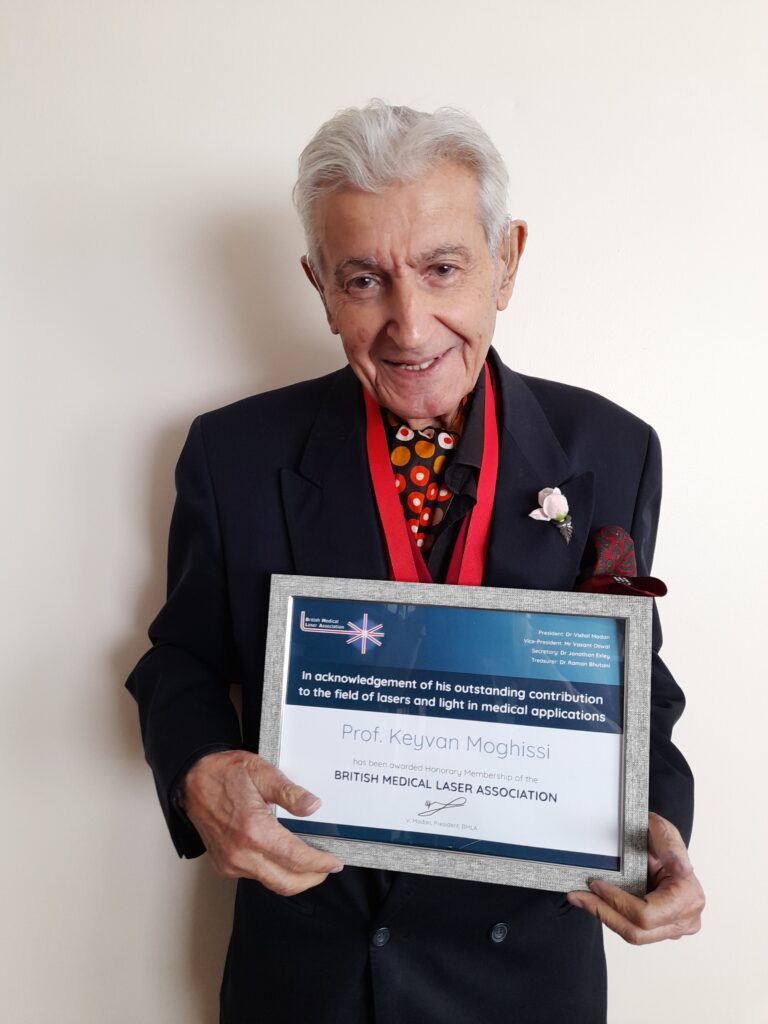
The BMLA awards Prof. Moghissi an honorary membershipto acknowledge his outstanding contribution to the field oflasers and light in medical and surgical applications.
In February 2021 it was a great honour for the BMLA and its President Vishal Madan to award Prof. Keyvan Moghissi a long standing Executive Board Member, an Honorary Membership as an acknowledgement of his outstanding contribution to the field of lasers and light in medical and surgical applications.
Prof. Keyvan Moghissi was first appointed as a Consultant Cardiothoracic Surgeon in Hull in 1970 and advanced quickly to become one of the UK’s leading cardio-thoracic surgeons before establishing and leading the Yorkshire Laser Centre, the project of a charitable trust, The Moghissi Laser Trust.
He became known as the Founding Father of the Thoracic Surgical Club and the European Association of Cardio-Thoracic Surgery (EACTS), and European Respiratory Society (ERS). In 1985, Prof. Moghissi undertook pioneering laser surgery of the chest, and was the first cardiothoracic surgeon to use a laser to remove secondary breast cancer from the lung without loss of lung tissue.
Additional career highlights have included:
Serving as the Editor-in Chief of the peer-reviewed journal Photodiagnosis and Photodynamic Therapy.
Organising very popular scientific sessions on photodynamic therapy at the annual BMLA scientific conference
Honorary membership of L’Academie de Chirurgie (Paris),
An honorary Visiting Professorship from Guang Zhou University (China)
Honorary membership of a number of other international and European Associations.
Awards for contribution to science and cardiothoracic surgery from Russia
An Award for Lifelong Contribution to Cardiothoracic Surgery from the World Society of Cardiothoracic Surgery.
Leading and providing high quality treatments outside the main laser centres
Setting up a Mobile Laser Unit to provide laser equipment and expertise at other hospitals to reduce the need for patients to travel long distances and by helping local consultants to deliver highest quality laser treatment at their local hospitals
Long standing Executive Committee member of the British Medical Laser Association.
The British Medical Laser Association (BMLA) was founded in 1980 and is the leading society for medical lasers in the UK. It’s membership comprises a wide range of individuals, including dermatologists, surgeons, nurses, beauty therapists, manufacturers, researchers and safety advisors. https://bmla.co.uk
Executive Board Members, Kerry Muggeson, Manager, Plastic Surgery and Laser Centre, Bedford Hospital NHS Trust and Kerry Belba, Clinic Director & Laser Practitioner, Laser Skin Solutions Ltd contributed to the Journal of Aesthetic Nursing Magazine – Skin & Laser Supplement in March 2021 with this article. Click here to read the featured online and in print article can be viewed here.
The BMLA are delighted to have both Kerry and Kerry as speakers at the Virtual Conference in May 2021. They are both involved in a dedicated Nurses and Therapists Session on Day 1 – Thursday 6th May which is always a very popular part of the programme.
Kerry Muggeson commented “I welcome the partnership of the BMLA and the Journal of Aesthetic Nursing. As a profession we are driven by knowledge, standards and education which enables us to provide excellent patient focussed care. By joining together, the nursing community can benefit from the BMLA who are able to provide evidence-based practice, training and networking for experienced nurses and those new to working in the field of lasers and skin”
Jon Exley, Managing Director of Lynton Lasers and BMLA Secretary contributed to the Aesthetic Magazine in August 2020 with this article. Click HERE to read. The whole issue online can be viewed HERE.
The Government’s announcement yesterday (9th ;July 2020) will now see aesthetic clinics to open from Monday 13th July 2020 in England. Initially, there will be certain restrictions which will mean “only services that do not involve work in the highest risk zone – directly in front of the face – should be made available to clients”. Whilst this restriction does not apply to treatments in a “medical setting”, clinics will be required to determine if or how they would safely carry out treatments such treatments.
Contained within the announcement are additional guidelines which include the wearing of visors by practitioners, appointment-only treatments and refreshments to be limited to the provision of water only.
Additional guidance, including more specific information on laser treatments, is available from the BMLA: